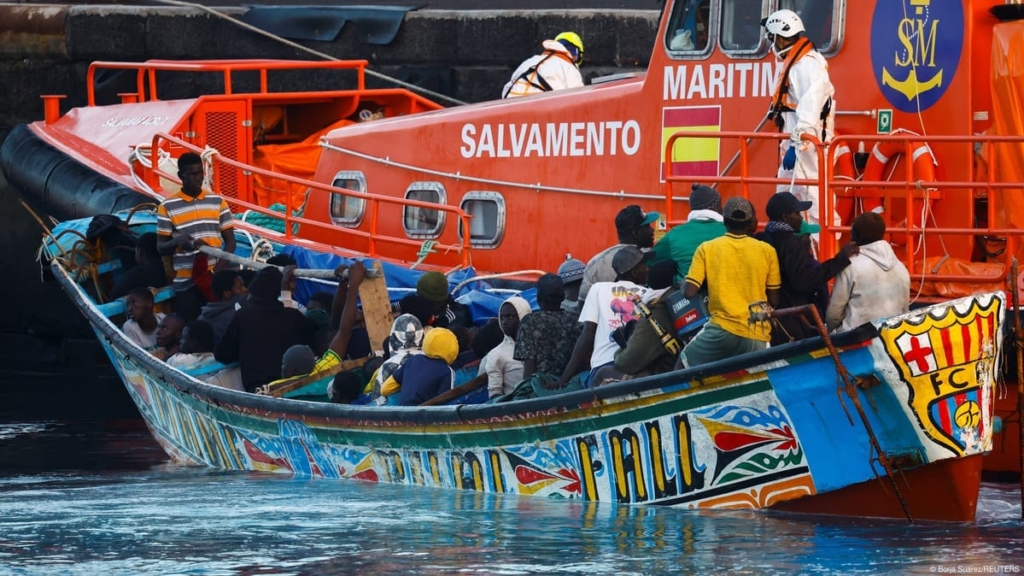
Around 900 people arrived on the island of El Hierro in five boats on Tuesday morning, following the arrival of more than 800 people in the Canary Islands on Monday.
The latest arrivals bring the number of people reaching the archipelago by sea this month to almost 13,000, according to figures recorded by Monday evening.
All five boats arrived at La Restinga, the fishing port on the southern coast of El Hierro. The first passengers came ashore before dawn, while the fifth boat docked at approximately 8.50am.
According to RTVE, around 11,000 migrants have arrived in El Hierro during November. The island has a population of approximately 12,000. Senegal, Gambia and Guinea are among the main countries of origin.
Arrivals increase after five-day break
The latest crossings follow a weekend during which seven boats carrying 429 people reached El Hierro, ending a five-day period without arrivals.
The numbers increased on Monday, when six boats arrived at La Restinga and another two were escorted to Los Cristianos, in southern Tenerife.
Maritime Rescue sources reported a combined total of 812 people, including 73 women and 48 minors. Another count put the figure at 815, with 635 people arriving in El Hierro and 180 in Tenerife.
The first boat reached La Restinga shortly before 1am, carrying 64 people, including four women and two children. Passengers told Red Cross workers that they had departed from Saint-Louis, in northern Senegal, six days earlier.
A second boat, carrying 88 people from Dakar, arrived at around 8am. Within the following hour, two more boats arrived from Gambia with a combined total of 281 passengers.
Two further boats reached El Hierro during the afternoon. One was carrying two pregnant women.
By Monday evening, a total of 12,960 people had arrived in the Canary Islands during November aboard 130 boats, commonly known as cayucos. Of these vessels, 109 had arrived in El Hierro.
The repeated arrivals have also affected local businesses. Residents in La Restinga say fishing and diving activities have been disrupted.
People arriving at the port are being taken to a temporary reception centre. Transfers to Tenerife by ferry and to mainland Spain by air are expected in the coming days to help ease pressure on reception facilities. Unaccompanied minors are being accommodated in specialist youth centres.
Canary Islands government calls for permanent arrangements for minors
Canary Islands president Fernando Clavijo was due to attend an interministerial meeting in Madrid on Tuesday.
On Monday, he called on the Spanish government to use its final cabinet meeting of the parliamentary term to establish permanent arrangements for transferring unaccompanied migrant minors to other regions under Article 35 of the Immigration Law.
Clavijo said the arrangements should not depend on annual renewals, which he described as a source of instability.
He also warned that the increase in arrivals had left the islands facing a situation of “saturation and inability” to provide the care required under international agreements.
The latest arrivals come during the final week of campaigning ahead of Sunday’s general election.
Socialist Prime Minister Pedro Sánchez is seeking to remain in office after eight years in power. The right-wing People’s Party (PP) and far-right Vox could seek to form a government together if they secure enough parliamentary seats.
Vox leader Santiago Abascal has recently described the migrant arrivals as an “invasion”.