
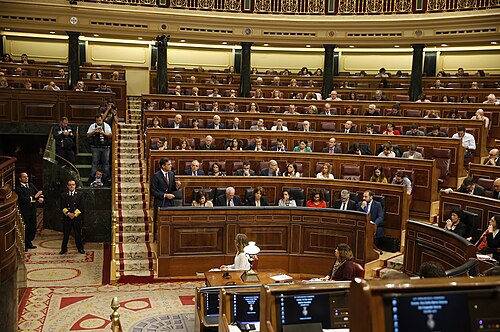
Spain’s Congress has approved a two-year extension for eligible rental contracts and prolonged eviction protections for vulnerable tenants until the end of 2030.
The decision was taken on Thursday, a day after a general strike over housing costs, wages and public services brought large crowds onto the streets across Spain.
However, lawmakers rejected a separate proposal that would have allowed tenants to renew their rental contracts automatically and indefinitely.
The votes took place just hours before the official start of campaigning for the 29 November general election. The right-wing People’s Party (PP), which leads most opinion polls, has pledged to repeal the approved measures if it comes to power.
The Basque Nationalist Party (EAJ-PNV) provided the decisive votes in both ballots. It joined the governing Socialists (PSOE), coalition partner Sumar and other left-wing parties to approve the first decree by 35 votes to 34.
The PP, far-right Vox, the Navarrese People’s Union (UPN) and Catalan pro-independence party Junts per Catalunya (JxCat) voted against it.
In the second vote, the PNV sided with those four parties, resulting in the indefinite rental renewal proposal being rejected by the same margin.
The votes were held in Congress’s Permanent Deputation, a 69-member body responsible for exercising certain parliamentary powers after the 350-seat lower house was dissolved ahead of the election.
Its composition gave the government a better opportunity to secure approval than it would have had in the full chamber. JxCat, whose seven MPs helped defeat both original housing decrees in October, has only one representative on the Permanent Deputation.
What the approved housing measures mean for tenants
Under the approved decree, eligible tenants can extend their rental contracts by two years, with rent increases capped at 2%.
Properties where rents already exceed the government’s reference price for the area cannot have their rents increased.
Social Rights and Consumer Affairs Minister Pablo Bustinduy said up to five million tenants could benefit from the measures. His ministry estimates that the median saving could reach €4,341.
The decree also extends eviction protections until the end of 2030 for tenants considered financially or socially vulnerable by social services, provided regional authorities cannot offer them alternative accommodation.
It also establishes that public authorities will cover costs resulting from suspended evictions, preventing small landlords from having to bear those expenses themselves.
Another provision, also remaining in force until 2030, prevents property companies from purchasing homes for less than 70% of their appraised value. The measure is intended to discourage investment firms, often described as ‘vulture funds’, from buying discounted properties in bulk for resale.
The wider package includes a 10% tax on tourist apartment rentals, tax incentives to encourage residential letting and government-backed loans to help prospective homeowners cover the deposit on a property they intend to occupy themselves.
Why the indefinite rental renewal proposal was rejected
The second decree, which failed to secure approval, would have given tenants the right to renew residential rental contracts automatically and indefinitely.
Under the proposal, landlords wishing to terminate a rental agreement would have been required to compensate tenants with an amount equivalent to one year’s rent.
Automatic renewals had been one of the main demands of housing campaigners. Opponents, however, argued that the measure could discourage property owners from offering homes for rent, reducing supply and pushing up rental prices.
PNV representative Maribel Vaquero criticised the government’s approach to consultation and argued that protecting vulnerable tenants should not come at the expense of supporting small landlords.
Meanwhile, the PP has made increasing housing supply the central element of its housing policy. The party has promised to oversee the construction of one million homes while reducing taxes and cutting administrative barriers for developers.
From a Madrid eviction to a nationwide general strike
Thursday’s parliamentary decisions followed Wednesday’s general strike, called over housing affordability, wages and public services.
The main trade unions organised the stoppage after Congress rejected the original housing decrees. Participation varied across the country, but demonstrations attracted large crowds in cities throughout Spain.
The housing movement gained momentum in September following the eviction of 87-year-old Madrid pensioner Maricarmen Abascal from the home where she had lived throughout her life.
She was forced to leave after the property company that owned the building imposed a substantial rent increase. She died shortly afterwards.
Her eviction was broadcast nationally and triggered demonstrations and protest camps in several Spanish cities. The largest was established in Madrid’s Puerta del Sol, where protesters remained for weeks.
Police eventually cleared the camp on 3 November, after more than a month.
In response to growing public pressure, Prime Minister Pedro Sánchez’s minority government introduced two emergency housing decrees.
Both were rejected by Congress in October, prompting Sánchez to call an early general election and bring forward a vote that had originally been scheduled for 2027.
The government subsequently presented two largely similar versions of the measures to the Permanent Deputation for consideration.
Housing becomes a major issue in the election campaign
Housing Minister Isabel Rodríguez linked the demonstrations directly to the forthcoming election, telling lawmakers:
‘Yesterday, the right to housing won on the street and in workplaces, and I hope it will win again at the ballot box.’
Bustinduy also defended the general strike and challenged opposition parties over the interests they were protecting.
‘What culture of hard work, what meritocracy, is there in someone who has inherited 100 flats putting up the rents by 40% because they can?’ he asked.
The PP called for Rodríguez’s resignation, blamed the government for rising housing costs and accused it of using the Permanent Deputation to overturn the decision taken by the full Congress in October.
PP lawmaker Sergio Sayas criticised the minister, saying: ‘You promised us more housing and have only given us tons of demagoguery.’
Vox representative Carlos Hernández Quero argued that government policies had reduced the availability of rental properties, leaving more people sharing overcrowded accommodation or continuing to live with their parents well into adulthood.
The government also faced criticism from some parties on the left, despite their support for the housing decrees. They accused Sánchez’s administration of responding too late to the crisis and allowing electoral considerations to influence its decisions.
Podemos leader Ione Belarra criticised Interior Minister Fernando Grande-Marlaska over police conduct during some recent demonstrations. Sumar MP Verónica Martínez Barbero also called for his resignation.
Political tensions intensify over housing measures
One of the most heated exchanges involved the two Catalan pro-independence parties.
Josep Maria Cruset, JxCat’s new parliamentary spokesperson following Míriam Nogueras, accused the government of exploiting the housing crisis for electoral purposes.
He also described Esquerra Republicana (ERC) spokesperson Gabriel Rufián as an ’emotional abuser’.
Rufián responded by accusing JxCat of siding with Vox. He held up a €50 banknote and referred to it as Cruset’s estelada, the flag associated with Catalan independence.
Rodríguez also criticised JxCat for helping defeat the original housing decrees in October. Addressing the party’s MPs, she said she hoped Catalan voters would put them where they deserved to be.
With the housing measures now partly approved and the indefinite rental renewal proposal rejected, housing policy is set to remain a central issue in the campaign ahead of Spain’s 29 November general election.
