
UK and EU reach agreements to ease food trade and expand opportunities for young people
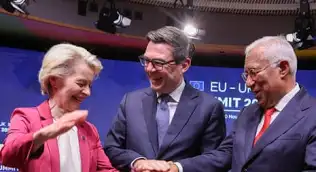
The United Kingdom and the European Union have reached a series of agreements in Brussels aimed at reducing post-Brexit trade barriers, linking their carbon markets and creating new opportunities for young people to live, work and study on either side of the Channel.
The agreements were announced on Friday at the second UK-EU summit since Britain left the bloc in 2020. They follow the commitments made at the first summit in London in May 2025, before Andy Burnham became prime minister in July.
European Commission President Ursula von der Leyen described the agreements as a “turning point”, while Burnham called them a “historic moment”.
“This is a good day for Britain and this is a good day for Europe,” Burnham said.
He estimated that the agreements could increase the size of the UK economy by 0.5%, revising his previous estimate of 0.4%. His government expects lower costs and fewer checks on food shipments to help reduce pressure on supermarket prices.
Food trade and carbon agreements
The food and agriculture agreement is intended to remove most of the certificates and inspections currently required for shipments of animals, plants and related products between Great Britain and the EU.
It will also simplify trade between Great Britain and Northern Ireland under the Windsor Framework.
Both sides aim to implement the agreement from 1 March 2028.
A separate carbon agreement, also targeted for 2028, would allow the UK and EU to recognise each other’s emissions allowances. This could exempt goods traded between the two markets from the other side’s carbon border charges, subject to the necessary legal procedures.
Discussions are also continuing over whether British manufacturers can qualify under the EU’s “made in Europe” rules.
Under the proposed arrangements, Britain would have to follow certain EU standards in the areas covered by the agreements, without having a vote in setting those rules.
Reform UK leader Nigel Farage criticised this aspect of the deal, describing it as a betrayal of Brexit.
“I’m afraid that the great Brexit debate has just started again,” he told the BBC.
Youth mobility agreed, but university fees remain unresolved
The two sides have also agreed to establish a Youth Experience Scheme allowing young people to spend up to three years in the UK or EU.
Participants would be able to work, study, volunteer, work as au pairs or travel.
The joint statement sets a target of implementing the agreement by 2028, with opportunities available no later than January 2030.
The UK is also due to rejoin the EU’s Erasmus+ programme in 2027.
However, university tuition fees remain unresolved. Negotiations continued until the final hours before the summit, with the issue proving one of the main obstacles to reaching an agreement.
The EU wants European students attending British universities to pay the same tuition fees as UK students. The British government has resisted this proposal.
London and Brussels have given themselves six months to reach an agreement on tuition fees in both directions. The proposed arrangement would cover students regardless of the immigration route they use.
Burnham rules out immediate return to the EU
Burnham has committed to keeping the UK outside the EU single market and customs union during the current parliament. He has also ruled out restoring unrestricted freedom of movement during this period.
However, he has left open the possibility of discussing Britain’s longer-term relationship with the EU, including arrangements that could involve closer customs cooperation or a future application to rejoin the bloc.
The question of EU membership remains divisive within the Labour Party. Recent polling suggests growing public support for rejoining, although the issue could provide Reform UK and the Conservatives with an opportunity to challenge the government ahead of the next general election, expected in 2029.
European Council President António Costa said the EU remained open to developing the closest possible relationship with Britain.
However, he also highlighted the obligations associated with EU membership, including the free movement of goods, services, people and capital.
Any application by the UK to rejoin the EU would require the unanimous approval of all 27 member states.
Ireland’s ambassador to the UK, Sonja Hyland, said Britain would first need to “make a clear decision as to what it wants”.
Cooperation on defence and migration
The summit also addressed wider cooperation between the UK and EU on defence and security.
Russia’s war against Ukraine has encouraged closer cooperation between London and Brussels in these areas.
The two sides also discussed irregular migration, including efforts to tackle the smuggling networks responsible for dangerous Channel crossings.
The agreements mark a further step towards closer UK-EU cooperation following Brexit, although several important issues, particularly university tuition fees and the longer-term relationship between Britain and the EU, remain unresolved.